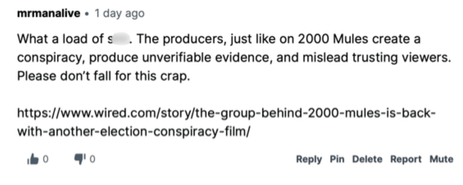
Hi Friend — No one has even seen the film yet. But the attacks have already started. We are preparing to release TRAPPED (Detroit) — a documentary built around real people, real records, and questions that deserve answers. Yet we are already being flooded with comments like the one below—people calling our work a “conspiracy,” warning others not to believe it, and linking to a recent story from the publication WIRED as supposed proof. Again, outside of our production team, no one has seen the documentary. In case you've never heard of WIRED it is a Condé Nast technology and culture publication that has increasingly moved into political reporting, where it has taken a distinctly progressive and consistently adversarial posture toward President Trump and his administration. They've written negative articles about us for years, just like hundreds of other outlets. Until now our general rule has been to just ignore them. We're not going to do that anymore. Instead, we’re going to show you the anatomy of these attempted takedowns—how a conclusion is chosen, how the facts are arranged around it, which answers are ignored, and how insinuation is made to look like reporting. Once you see the pattern, it becomes much easier to recognize. And in an age of relentless information warfare, the ability to see through the hype and think for yourself has never been more important. Their most recent reporting describes us as the group “responsible for” the “debunked” 2000 Mules. So, a little history matters. First, True the Vote did not make 2000 Mules. I believe the film was enormously helpful in waking millions of Americans up to serious vulnerabilities in our elections. But it was not our film, and it is simply inaccurate to describe True the Vote as the group “responsible for” it. Our work began long before the film. In late 2020, after speaking with several confidential sources, we began purchasing and analyzing geospatial data in and around ballot drop boxes and nonprofit organizations. We identified patterns we believed warranted further investigation and took our findings to law enforcement, including the FBI and the Georgia Bureau of Investigation. That was more than a year before anyone discussed using the work in a movie. When the Washington Post later asked Dinesh D’Souza how much editorial control True the Vote had over 2000 Mules, his answer was simple: “Zero.” We stand behind the work we provided. But we did not write the script, choose the cuts, shape the narrative, or control the presentation. Our position was always that geospatial data was sufficient evidence to support probable cause — a lead that law enforcement to follow to de-anonymize devices, interview people, subpoena records, and investigate. We couldn’t do those things. Authorities could. We secured data from the same sources used by authorities. We had analysts in common, so there could be no question as to credibility. But something extraordinary happened as politicos became aware of our project: The discussions we were having about investigations into our data stopped. To our knowledge, every investigative effort involving the data we had provided came to a halt. The evidence wasn’t followed through to its logical conclusion. The devices weren’t de-anonymized. The people behind the patterns weren’t investigated. And the media dutifully began to spread the talking points that we had been "debunked". There is now sworn testimony raising serious questions about why. In previously sealed Fulton County grand-jury testimony, former U.S. Senator David Perdue testified that then-GBI Director Vic Reynolds had reviewed evidence involving cell-phone data, video, testimony and bank records and considered it compelling enough to investigate. Perdue further testified that Reynolds later told him: “I’m a team player. If the governor doesn’t want to investigate, we’re not going to investigate.” Read the grand-jury transcript archive: 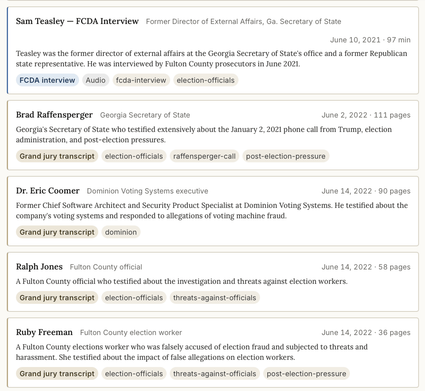 |
Read the report on Perdue’s testimony:  |
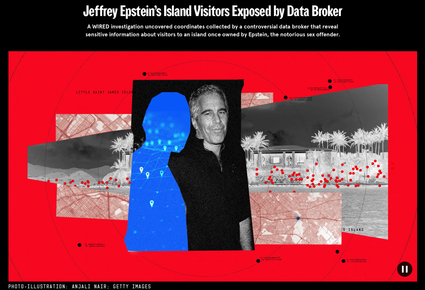
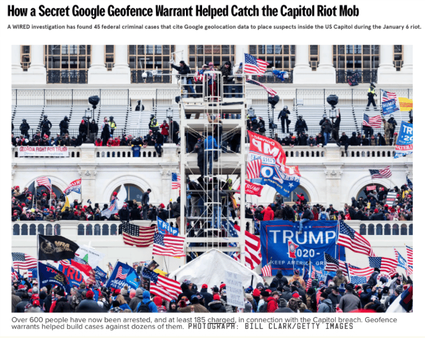
WIRED Trusts Geospatial Data—Until True the Vote Uses ItNow consider this. WIRED has repeatedly reported on the accuracy of geospatial evidence. When WIRED investigated visitors to Jeffrey Epstein’s island using commercially brokered location data from the advertising ecosystem, WIRED said the coordinates could pinpoint locations “within a few centimeters.” They used that data to trace movements, routes, homes and workplaces. Read WIRED’s Epstein geolocation investigation: When the FBI used geofence data after January 6, WIRED described location technology capable of placing phones “within a few yards.” Read WIRED’s January 6 investigation: Different datasets have different capabilities, to be sure, but WIRED clearly understands that geospatial information can be powerful investigative evidence. So, why disparage ours? Because our evidence didn't serve their narrative. And the catcalls that we'd been "debunked" were erroneously echoed all over the country. Investigate the evidence. That was all we asked for. Instead, the investigations stopped, 2000 Mules became the target, and now that same label is being used to tell people what to think about TRAPPED (Detroit) before they have even seen it. And While We Were Preparing This Very Email ... WIRED Strikes AgainIncredibly, while we were preparing this response, WIRED published another hit piece on us. Here it is — written AFTER I'd talked with the reporter, David Gilbert. This time the headline itself calls Gregg Phillips the “Waffle House Teleporter” — taking one of the most vulnerable moments of a man’s documented battle with metastatic cancer and turning it into clickbait — even after he knew the full story, because I'd shared it with him. Disgusting. Then the story piles on. WIRED says Gregg had “no past experience working in emergency response.” That is not true. Gregg spent decades working on the ground in disaster zones through nonprofit and faith-based efforts, including work surrounding Katrina and Haiti. Even WIRED’s own coverage quotes FEMA praising Gregg’s ‘service, dedication, and leadership’ and saying he played a ‘pivotal role’ in stabilizing the Office of Response and Recovery and advancing reforms. Then WIRED reaches backward to suggest there is some mystery about Gregg’s relationship with True the Vote because he once served on our board. There is no mystery. Gregg served on True the Vote’s board from 2014 through 2017. He later assisted us as a contractor on research from 2020–2023. He is not currently a board member, employee, or member of the True the Vote team. We think Gregg is great. He supports our work. He has appeared on my podcast. I have spoken publicly about his battle against cancer. But he has not “come back to work with True the Vote.” WIRED also resurrects years-old financial allegations wholly unrelated to Gregg’s current government status or TRAPPED. I am writing a full response to address those separately and will post on our website. It's all nonsense, but because we seem to again be in the eye of the storm, and I'm sick of it, we're going to address every allegation. Even then, mark my words: it will never be enough. Their goal is not honest reporting. No answer I give, no documentation I provide, and no factual error I correct will ever change the story they have already decided to tell. And that certainty is especially striking coming from WIRED reporter David Gilbert. Living thousands of miles away in Ireland, he repeatedly tells Americans what to think about local election disputes, while the citizens actually living through them struggle to get their evidence heard. WIRED — and their cohorts — have been doing this for years: decide the conclusion, attach the label, and discredit the evidence before readers ever get a fair chance to consider it. That is not reporting. It is narrative enforcement. President Trump calls it “fake news.” Whatever label you prefer, the pattern is impossible to miss. I hoped for better from WIRED. I really did. My hopes were misplaced. A Word About Ramon JacksonAnd while we are correcting the record, a word about Ramon Jackson. Ramon is one of the Detroit citizens whose firsthand experiences, affidavits, and years-long legal fight are part of the story documented in TRAPPED (Detroit). WIRED invokes the dismissal of his lawsuit as a reason readers should doubt the documentary, so it is important to understand what actually happened. WIRED tells readers that Ramon’s lawsuit was dismissed, but leaves out an important distinction: His case was dismissed at the pleading stage. There was no trial. There was no evidentiary hearing. And there was no judicial finding that the experiences Ramon and other Detroit citizens documented were false. Ramon had no army of lawyers. He filed pro se, kept fighting through the Sixth Circuit, and ultimately carried his case to the U.S. Supreme Court. For years Ramon has been trying to get someone to actually hear the evidence. No one has. Justice delayed is justice denied. That is one reason TRAPPED (Detroit) matters. TRAPPED (Detroit) is not a movie built around a political narrative. It is a documentary investigation. It centers on Detroit citizens, public records, sworn statements, litigation, government documents, and questions that have been buried or ignored for years. And if we're already being flooded with attacks before the public has even seen the evidence, that should tell you something. Don't let anyone do your thinking for you.For years, we have absorbed labels, smears, and shorthand characterizations while continuing to do the work. We have had enough. It's time to fight back. TRAPPED (Detroit) is over the target and the Call to Action, to check your own record using Scan. Check. Protect, is one of the few remaining ways to improve election integrity before the midterms. Please help spread the word. Do not wait on government to act. Do what you can, now. Keep the faith. Never quit. Ephesians 6 FTW! Ever onward — P.S. — Olive branch withdrawn, WIRED. I had planned to end this letter by saying something positive about WIRED. I reached out to them in good faith and we'd had several conversations. And yet they still chose to publish another hit piece, resurfacing years of fake news about us and citing it as fact, then piling on with fake news of their own. Here is what really bothers me about this story, this time. I answered David Gilbert’s questions. WIRED used part of my response — and then told its readers I “did not respond” to the question about Gregg’s former role on our board. That is not true. I did respond. I specifically explained that Gregg joined the board in 2014 and rolled off in early 2017. I also explained the IRS filing issue: a former CPA failed to remove Gregg’s name from a later return, our accounting was subsequently moved to new CPAs and auditors, and corrected filings were made. I even explained that the IRS website itself currently shows multiple filings and broken links, including 404 errors that appear to involve amended returns, none of which do we have any control over. You may not like my answer. You may decide not to use it. But you cannot tell your readers I failed to respond when I did. So — my outreach got us a headline mocking Gregg, recycled false allegations from years ago, a misleading account of Gregg's FEMA experience, an errant implication about his relationship with True the Vote, and yet another judgment about a documentary the reporter has never seen. There is no value in any of this other than to needlessly foment more anger. This is exactly why we stopped talking to reporters. And so, to WIRED, because I know you will read this, consider this P.S. a direct request to correct the record. You state that Gregg had “no past experience working in emergency response.” That is false as written. Gregg has spent decades responding to disasters and leading relief efforts through nonprofit and faith-based work. If what you mean is that he lacked previous federal emergency-management experience, say that. You state that I did not respond when asked about Gregg’s former board role. I did respond before publication and provided both the board timeline and an explanation of the IRS filings. Correct that statement. You state as fact that TRAPPED (Detroit) “makes allegations about widespread and systemic voter fraud,” despite the fact that you have not seen the documentary. If you have not reviewed the film, you cannot truthfully tell your readers what it alleges. Retract or substantiate that statement. And in your earlier coverage, you told readers that Ramon Jackson’s lawsuit was dismissed for “failure to produce sufficient evidence.” His case was dismissed at the pleading stage. There was no trial and no evidentiary hearing adjudicating the truth of the evidence he brought forward. You should correct that characterization as well. This is not the first time you've been notified. I genuinely hoped we could find common ground around something much bigger than any of us: the profound risks artificial intelligence now poses to America’s technically vulnerable election infrastructure. That's why I reached out to know. You know that. The blessing and curse of AI has arrived at the doorstep of thousands of local election offices — many with little or no dedicated IT staff. We have to start talking seriously about what that means. Maybe someday we can talk about it with WIRED, but not today and not for the foreseeable future. For now, I’m done talking to — or about you. Oh, except for the pending litigation against you. I now look forward to that conversation. |