| Read Online The window to learn how to spot a copy-paste bill...and write one of your own. Highlights: - "Model legislation" is pre-written bill language built to spread across states. Some of it protects liberty. Some of it slips in quietly. Knowing the difference is the whole game.
- You don't need to be a lawyer to draft a bill, and LegiTrack has an 8-step path from idea to introduced.
- The quiet season is prep season. This is when you learn the process, so you're ready the moment your legislature gavels back in.content here...
|
Hi Friend, Right now, only six state legislatures are still in session, which leaves California and North Carolina running through August, and Michigan, New Jersey, Ohio, and Pennsylvania grinding on into the winter. Everywhere else, the lights are already off. Here's the thing about the quiet season: it isn't quiet everywhere. While the public tunes out, something else tunes in. This time, however, is different: You're actually paying attention. This is the stretch when bill language gets drafted, circulated, and quietly loaded into the chamber - ready to drop the moment lawmakers return. And a lot of that language isn't homegrown. It's copied. Meet the copy-paste billThere's a name for pre-written legislation built to travel: model legislation. Advocacy groups, think tanks, and national networks like ALEC, NCSL, the ACLU, Heritage, and others draft bills designed to be dropped into multiple states with little more than the state name changed. Think of it this way: one template, fifty possible destinations. Sometimes that's a good thing. A strong, well-tested bill that protects election integrity in one state is worth copying into the next. These bills are also fantastic examples to "model off of" for citizens who want to help, but don't really know where to start. But model legislation has a quieter cousin: language that spreads state to state without citizens ever realizing the same bill is landing in their capitol that landed in three others last spring. Same words and mechanism with different letterheads...and no "fingerprints". The villain here isn't a person. It's anonymity - a bill with no clear author, no local origin, and a national agenda riding underneath the "uniform standards" verbiage. You can't fight what you can't see, so the first job is learning to see it.  Access the full bill tracker Access the full bill tracker |
How to spot oneModel bills are designed to be portable, so there are specific giveaways. Watch for language like "A bill to ensure uniform standards…" or "This act shall be known as…" A good model bill worth supporting does five things: - It solves a specific problem
- It's easy to understand
- It is constitutionally sound
- It can actually be enforced
- It has a real mechanism for action instead of vague, "encouraged" language.
Test each one. If it aligns with liberty, help build the momentum to pass it. If it threatens liberty, dig into where it came from, show citizens how it played out in other states, and hand lawmakers better language. On November 5, 2024, Iowa and Wisconsin voters approved constitutional amendments that made the identical change: "every" became "only": 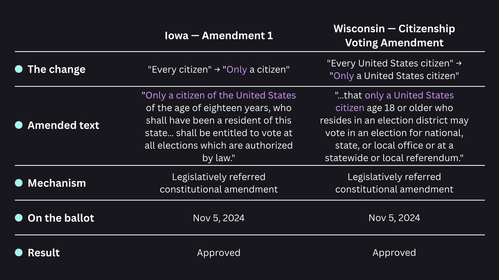 |
Different states, bill numbers, and legislators with the same idea, fix, and single-word edit. That's the tell. And it wasn't just these two. In 2024, the same "every → only" change was on the ballot in eight states at once: Iowa, Wisconsin, North Carolina, South Carolina, Idaho, Kentucky, Missouri, and Oklahoma. And the trail runs back further: North Dakota started it in 2018, five more states followed across 2020 and 2022, and then came the eight-state wave. One template, marching state to state, year after year. You can write one yourselfHere's the part most people never hear: you don't need a law degree to draft a bill. Many of the most effective bills were written by regular citizens. Clear, logical writing focused on a single issue beats legal jargon almost every time. Only elected lawmakers can formally introduce a bill, but you can write the draft and find a sponsor. If your legislator won't carry it, find one who will. A local rep, a state senator, or even a city council member might be more aligned. Build public support and show them it's a winning issue. And if it doesn't pass the first time, it still starts the conversation, shifts opinion, and often wins the next session. LegiTrack breaks the whole path into eight steps: Brainstorm → Research → Draft It → Build Support → Find a Sponsor → Promote → Track → Advocate. Idea to introduced — with a map for each step.  Subscribe and stay connected. Subscribe and stay connected. |
Why nowWhen your legislature reconvenes, the bills will already be written. The hearings will move fast...we've watched election laws go from introduced to signed in as little as 31 days. Sometimes less. The handful of states still in session are the exception. For everyone else, this is your window. Use these quieter weeks to learn the process, build your bill-comparison team, and prepare. Then when the copy-and-paste bills arrive in your state capitol, you won't be scrambling to catch up - you'll be ready to lead. Today's quiet season is next session's fight. Let's spend it getting ready. Ever onward - |