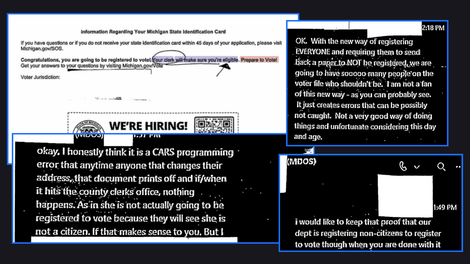
| Read Online ICYMI, a lot is going on in Michigan, and most of it applies to any state. Highlights: - Michigan's own press release says only citizens qualify for automatic registration — and never says who checks.
- A sheriff, a system called CARS, and five criminal charges. What's proven and what isn't.
- Four bills would close the gap. Not one has a hearing date.
|
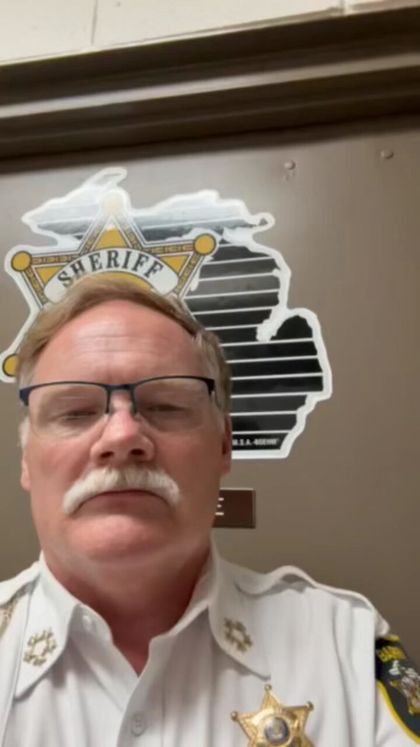
Hi Friend, Michigan already wrote down the answer: an actual bill saying who must verify citizenship before your neighbor becomes a live voter record. It passed the Michigan House on April 14...and has been sitting in a Senate committee ever since. Over 300 days. No hearing, no vote, no public argument at all. Hold that number, because this Michigan has turned into the Spider-Man meme — you know the one where all the Spider-Men are pointing to each other? The Department of State, the Bureau of Elections, branch offices, the Qualified Voter File (QVF), city and county clerks, federal agencies — everybody holds a piece, and everybody is pointing at somebody else. The difference is that the clerks are actually asking for help. Underneath it is the question LegiTrack users should be asking: did Michigan law assign responsibility for verifying eligibility — and give that person the information to do it? Read the State's Own Press ReleaseHere's how it works as of June 1, 2026, per MDOS's own announcement: you complete a qualifying transaction at a branch office, you're registered at that moment, and then a letter goes out with a form you can mail back to opt out. That announcement says only U.S. citizens are eligible. Then it walks the entire workflow — transaction, registration, notice, opt-out, QVF — and never describes a citizenship verification step. MDOS now says its systems automatically filter known noncitizens before the registration process begins — but that raises the very question Michigan clerks are asking: what information is used to make that determination, and who can actually see it? That's not an allegation. That's the state describing its own "machine"...and a question about how that machine actually works. "Ask the Clerk."Michigan requires voters to affirm citizenship under penalty of perjury. But clerks (the people processing those registrations) say they can't see the citizenship data to verify it. So who verifies, with what information, and at what point? A safeguard only works where responsibility and information meet. What's Actually AllegedBarry County Sheriff Dar Leaf has taken documents to federal authorities after a whistleblower alleged the Secretary of State's CARS system is programmed to tell noncitizens they've been registered to vote. The state's answer is flat. Chief communications officer Angela Benander says CARS "has guardrails that do not allow non-citizens to register to vote," employees can't bypass them, and Leaf's claims are more conspiracies. Then, on August 28, Leaf answered back with a new occurrence that negates Benander's claim: Cue the Spider-MenLegislature: We wrote the law. 👉 MDOS: The process complies. 👉 The Secretary of State: I've recused myself — voluntarily. 👉 The statute: I never said she had to. 👉 The clerk: I process it, but I can't see federal citizenship records. 👉 The feds: Those are over here. 👉 Everybody: 👈 👉 👈 👉 Michigan's Secretary of State is running for Governor. In May she announced a firewall recusing herself and handing certain duties to Elections Director Jonathan Brater. She wrote it herself. No statute requires it, or defines its edges. At the top of the org chart, "who checks?" means whoever holds the office decided — in a press release.  Access the full bill tracker Access the full bill tracker |
Four Bills. Zero Hearings.Lawmakers have already filed the fix...and all four die in December when the two-year term ends. HB 4765 — Proof of citizenship to register, ID to vote, with a "federal-only" category for anyone who can't document it yet. Passed the House 58–46 April 14; in Senate Government Operations since April 16, untouched.This is the bill that answers the question. Opponents cite 15 flagged cases out of 5.7 million ballots. Fine. Hold the hearing and put that on the record too. HB 5845 — Keep poll book flash drives 22 months instead of wiping and reusing them. Passed the House 62–45 June 17 with votes from both sides; in Senate Elections and Ethics since June 23. You can't file a records request for a drive that was erased. HB 5968 — Transfers election duties to the deputy when the Secretary of State is a candidate. In House Election Integrity since May 13, no hearing. Panel three of the meme, in bill form. A statute survives the next election. A press release doesn't. SB 943 — Audits after every primary and general. McBroom (R), the Republican who ran the Senate's own 2020 investigation. In Senate Elections and Ethics since May 7, no hearing. If the safeguards work, an audit is how the state proves it. Meanwhile, on August 27, a new election bill was introduced, read and referred to committee the same day — the only Michigan election bill to move in two weeks. The chamber is meeting and the committees are open. "No action" is an action somebody chose. What Can YOU Do?Ask these specific questions: Which office is legally responsible for verifying citizenship, what information does it receive to make that determination, and where is that responsibility written in law? Then ask your state senator: Use Michigan's HB 4765 as an example. No matter what state you're in, ask: Would legislation like this change anything here? Does your state already require documentary proof of citizenship? Does it rely on attestation or database checks? And most importantly — who actually performs the verification? You don't have to be a legislator to spot a gap between what a law requires and what the people administering it can actually do. Talk to your clerk. Ask how the process works on the ground. Then document it. Get the statute. Get the manual. Get the written procedure. File a public-records request when appropriate. Then put them side by side: What does the law say should happen?
What does the procedure say should happen?
What actually happens? If those three answers don't match, you've found a question worth taking back to your lawmakers. That's citizen oversight. Legislation Is the BlueprintLaws create systems. Systems assign responsibility. Clerks operate inside them. Citizens live with the result. So when nobody can plainly answer "who checks?" — open the law. Find the responsibility. Follow the legislation. And you may find what we found in Michigan: the answer isn't missing. It's on page one of a bill in a drawer, nearly one year into a silence nobody has to explain. Ever onward - |