Let's Do This. Together. Hi Friend, Of all the questions we hear, this is the one that comes up most: "I want to help. Where do I start?" Today's TTVN Live answered it, and the answer might surprise you. Most people assume working at the polls begins on Election Day, but it doesn't. And that's actually good news, because it means there's still time. There's still time for you.
Newsletter highlights: - The #1 question we hear — "I want to help. Where do I start?"
- Catherine's counterintuitive tip: serve inside the process before you ever try to investigate it (it's how TTV began)
- A role-by-role breakdown from the easiest entry point to the ones needing training, plus exactly how to get plugged in
- The training truth most people miss: guidance courses ≠ the certification your county requires
What if you've never worked in an election?Don't worry about becoming an expert overnight. You just have to begin. As Catherine put it on yesterday's TTVN Live episode, now is the season to find where you fit. She ran through the various roles: poll workers, poll observers, precinct volunteers, citizen researchers, legislative advocates, public records investigators, voter registration teams, community educators — there isn't one way to serve. There are dozens. The only wrong move is waiting until Election Day to start. 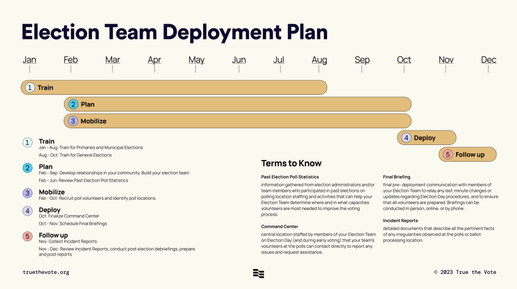 Above is a general guideline for preparation, but you can begin now! Above is a general guideline for preparation, but you can begin now! |
Here's the part that catches people off guard...Our strongest advice is to volunteer inside the election process before you ever try to investigate it. Master tip...this is how Catherine was inspired to start TTV! Work a polling location, observe an election, and watch how check-in works and how ballots actually move. Once you've seen how elections really function, everything else clicks into place as your research gets stronger, your questions get sharper, and your conclusions get more accurate. Context is everything. Did you know there are a variety of positions?Here's the lay of the land, from easiest entry point to the ones that need a little more training: - Poll Watcher/Observer (also called poll challenger, depending on your state) — The best place to start if you've never done this before. You work on behalf of a party or candidate and simply observe the process. You don't talk to voters; if you see something, you report it to the judge running the polling place. Watch, take notes, learn how it all works.
- Election Worker (behind the desk) — The most-needed role, because the polls can't function without it. You work for the county during the election period as a paid contract worker, checking registrations and getting voters their ballots. The goal is parity of party at the polls: equal Republican and Democrat representation. In many places, the Republican side is short-staffed, and both parties need to be present to make this work.
- Mail Ballot Review Board — Review incoming absentee ballots and verify the signatures on security envelopes. (Some states have shifted this to automated AI review, so availability varies.)
- Central Count Worker — Serve at the collection points where ballots are returned and tallied after the polls close. We all remember how 2020 looked in those counting rooms; this is where citizen eyes are essential.
- Deputy Voter Registrar — Get certified to register voters in your community. (We'll dedicate a whole podcast to this one soon!)
How to get plugged in: Go to Engage → Toolkits or → Info by State on our website. Pick your state, use the Party Info link to connect directly with the party of your choice, and check the Election Info tab for your local "become a poll worker" link. You can also call your county or your local party or candidate directly and ask, "I want to serve, what are my options?" One thing the online forms can't replace: at some point you'll need to talk to a real person to get on the calendar and assigned. And you'll almost always need to complete a training first. And an important note: Organizations like True the Vote, establishment and party groups, and other well-meaning volunteers will provide training for guidance purposes. These important courses are generally the "how-to's" and "what if's" for working at the polls (especially if you don't know where to start!), but they do not replace the certification process that is almost always required. I cannot tell you how many disheartened emails we receive on Election Day from citizens who were led to believe they sat through a course and felt prepared to work the polls, only to be told that they never properly registered, took the class, and got certified through their county. Always make sure you check with your local elections office to confirm you take the required course(s) to be properly trained up and certified. The time you put in early counts more than we can express.We say it often at True the Vote: safeguarding elections was never meant to rest on a handful of "experts". It rests on an engaged citizenry. Some volunteers spend hours on research. Some file open records requests or track legislation. Some work the polls, and some pray. Some simply nudge a neighbor to get involved. Every one of those roles counts, because confidence in our elections isn't built by one organization, and it certainly is not built by the parties. It's built by citizens who choose to participate. So if you've been waiting for the right moment to start, this is it. And there's still time! Let's get to work. Ever Onward! "One who is faithful in a very little is also faithful in much..." - Luke 16:10 |